
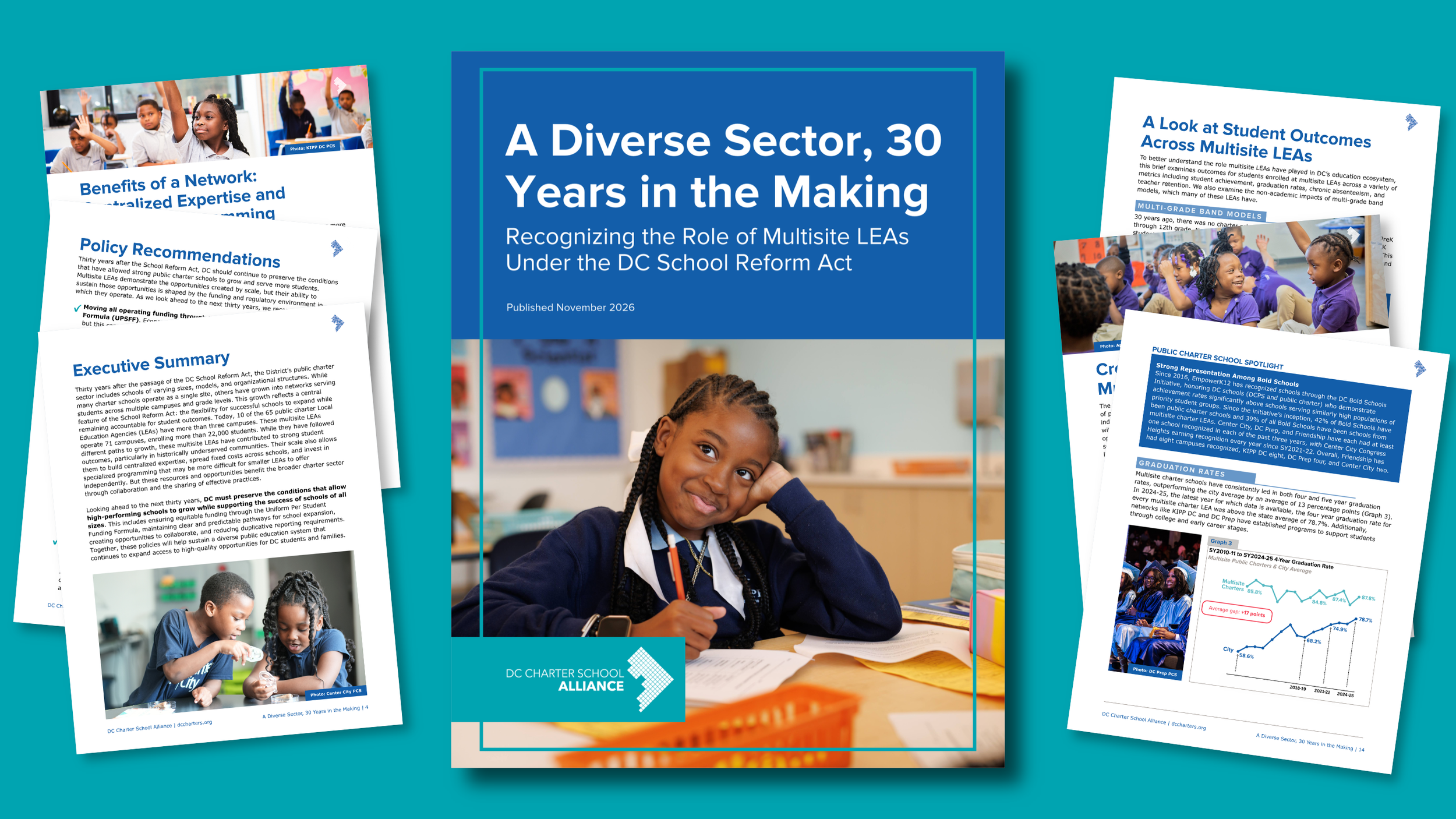
This year marks 30 years since the DC School Reform Act (SRA) created DC's public charter school sector. To mark the anniversary, the DC Charter School Alliance has published two policy briefs on how the law shaped public education in the District. The first, Thirty Years of Chartering, was published in December 2025 and focused on single-site charter schools. This second brief looks at multisite LEAs: how they grew and what they do for DC students.
The SRA gave successful schools the flexibility to grow while holding them accountable for student outcomes. Today, 10 of DC's 65 public charter LEAs operate three or more campuses. Together they run 71 campuses and enroll more than 22,000 students, or 22% of all public school students in the District. Many started as a single school and expanded over time, and some have merged with or acquired struggling schools so students could stay enrolled instead of facing a school closure.
LEAs of varying sizes are essential to the diversity of DC’s charter sector. Together, they offer families a range of school models and organizational approaches. This mix is an important strength of DC’s public education system.
Key findings:
Multisite LEAs enroll more at-risk students than the charter sector overall and the city average. Since 2015, their schools in Wards 5, 7, and 8 have outperformed the city average in math and ELA.
In 2024–25, every multisite LEA's four-year graduation rate was above the state average.
Since SY2021–22, multisite LEAs have cut chronic absenteeism by more than twice the citywide reduction.
Their size lets them build programs that smaller schools would find hard to offer alone, such as teacher residencies, support for alumni after graduation, and specialized STEAM facilities. They often share these resources with the rest of the sector.
The brief recommends:
Moving all operating funding through the Uniform Per Student Funding Formula (UPSFF)
Keeping clear, predictable ways for successful schools to grow and to partner with schools that are struggling
Making it easier for schools to collaborate and share what works
Cutting duplicate and burdensome reporting requirements
