
DC Charter School Alliance Marks 30 Years of Charter Schools in DC
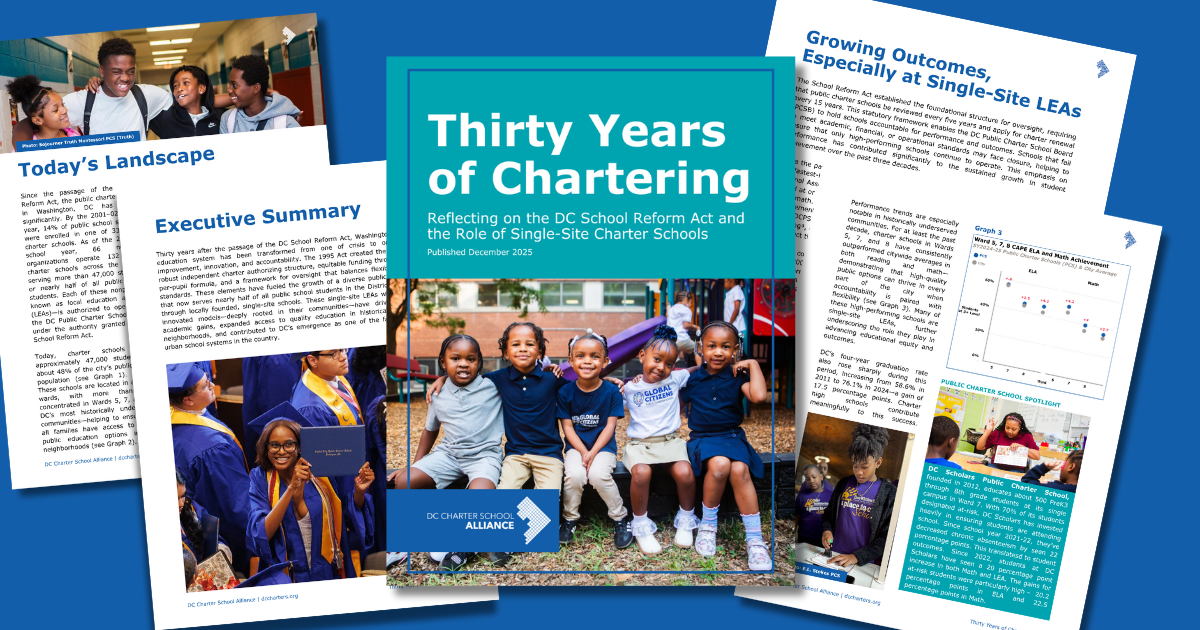
Pages from the new policy brief from the DC Charter School Alliance
A new policy brief and podcast reflects on the DC School Reform Act and the role of single-site charter schools.
DC Alliance calls for protecting equitable funding, sustaining strong, independent authorizing, and reducing duplicative compliance burdens to maintain the spirit of the SRA
WASHINGTON, DC – Today, the DC Charter School Alliance released a policy brief entitled Thirty Years of Chartering: Reflecting on the DC School Reform Act and the Role of Single-Site Charter Schools in advance of the 30th anniversary of the landmark DC School Reform Act (SRA), which established school choice in the District. In conjunction, the DC Alliance also released the first episode of a new podcast series, Leaders in Conversation, featuring DC Scholars Public Charter School Head of School Amy Helms, Thurgood Marshall Academy Executive Director Raymond Weeden, and Center City Public Charter School President & CEO Russ Williams. The episode focuses on student growth and achievement, progress on CAPE, and strategies that can be scaled.
The report details the trajectory of DC's education system from underperforming to becoming one of the most innovative school districts in the country. That progress stems in part from the expansion of charter schools, which employ unique learning models, tailored programs, and specialized curricula to cater to the students' needs. The SRA paved the way for the steady expansion of charter schools over three decades, particularly in Wards 5, 7, and 8, where there are higher concentrations of economically disadvantaged learners. These students often lacked access to rigorous options, but now many of them are thriving academically because of charter school education.
The report highlights how charter schools across the city, particularly single-site LEAs, have contributed to significant gains for students. These improvements include growth in the number of learning days for reading and math, an increase in DC's four-year graduation rates, and overall improvement on the annual DC CAPE assessment. It also includes policy recommendations to ensure that the spirit of the SRA is strong in the local policies that govern schools: protecting equitable funding and ensuring access to quality facilities; sustaining strong, independent authorizing; and reducing duplicative compliance burdens.
"Our school system has evolved over the last 30 years, but our commitment to our students has never changed. DC is leading the nation in education because of dedicated school leaders, educators, policymakers, and community partners who leveraged the School Reform Act to imagine a better future for new generations of students. Each day, charter schools are executing on that vision in a big way," said Ariel Johnson, Executive Director of the DC Charter School Alliance. "We are extremely proud of the impact that charters have made and continue to make in the lives of students in DC. Our institutions, especially single-site LEAs, have helped to advance educational equity in the city and expand what is possible for every student, no matter their background or zip code."
Today, DC stands as a national leader in educational progress, ranking first among U.S. states in pandemic recovery. Nearly half of all public school students, more than 46,000 learners from age 3 through adulthood, attend DC's public charter schools. These homegrown institutions, 89% of which were founded in DC, offer over 40 distinct program models that cater to the unique needs of their communities. Despite half of all charter school students being designated "at risk" of academic failure, many continue to defy expectations. These students are achieving stronger learning outcomes and graduating at higher rates because they are receivinggaining the targeted support they need to thrive.
On the Leaders in Conversation podcast, Amy Helms of DC Scholars Public Charter School emphasized the importance of unique learning models in achieving success for their Ward 7 students. "The data came back immediately, and it was evident the students who are in tight small groups or one-on-one intensive dosage, were far outperforming others who weren't in those interventions. So there was no question, this is where we have to go,” said Helms.
"The joy of being a charter school is that two people and I are a central office," said Raymond Weeden of Thurgood Marshall Academy, which is located in Ward 8. "People knock on my door and say, 'We want to change this,' and we can do that. If you can come up with how we can get there in a way that makes sense, we'll help you figure out the rest to implement it."
Under Russ Williams' leadership, Center City Public Charter School opened the Makerspace, a Ward 5 STEAM-centered learning facility, as an innovative strategy to promote student learning. "We strongly believe that hands-on science, technology, engineering, arts, and mathematics creates joy of learning," said Williams on the DC Alliance podcast. "Students are learning collaboration, cooperation, and readiness skills that help them identify and understand interests beyond English and math."
For full access to the report, click here.
###
About the DC Charter School Alliance
The DC Charter School Alliance is a 501(c)(3) organization that advocates for DC charter schools and their students. Learn more at www.dccharters.org.