The Numbers Don't Lie: The FY27 Budget Proposes Deep Inequity for Charter Students
By Tami Lewis
Senior Director of Government Affairs, DC Charter School Alliance
Nearly half of DC's public school students attend charter schools. Charter schools overwhelmingly serve students of color and students from economically disadvantaged families across all eight wards in DC. For nearly 30 years, DC has been nationally recognized as having one of the most equitable public school funding systems in the country — because we built it on a simple, powerful principle: every public school student deserves appropriate resources to receive an excellent public education.
The Mayor's proposed FY27 budget takes direct aim at that principle.
What's Being Proposed Takes the Biggest Bite Yet Out of DC's Most Equitable Education Policy
DC's Uniform Per Student Funding Formula (UPSFF) is the backbone of equitable public education funding. It is how the District distributes resources to every public school student — whether they attend a charter school or a DCPS school — on a per-pupil basis, applying weights for grade levels, students with disabilities, and at-risk students. Schools use those resources to cover all of their operating costs: paying teachers, running programs, and keeping the lights on. That's the deal. That's what makes the formula fair.
Charter schools are also held to high standards – as we should be – in terms of producing strong academic outcomes, and ensuring consistent leadership and the development of our teachers. But, as KIPP DC leader Shannon Hodge recently testified during a Budget Oversight Hearing before the DC Council, meeting the city's expectations requires resources and funding. Charter schools cannot realistically achieve the goals of exceptional student outcomes, teacher retention and reducing of chronic absenteeism if we are so severely underfunded. For so many of our schools, it will hinder our ability to conduct and execute long-term strategic planning that supports our students and our communities.
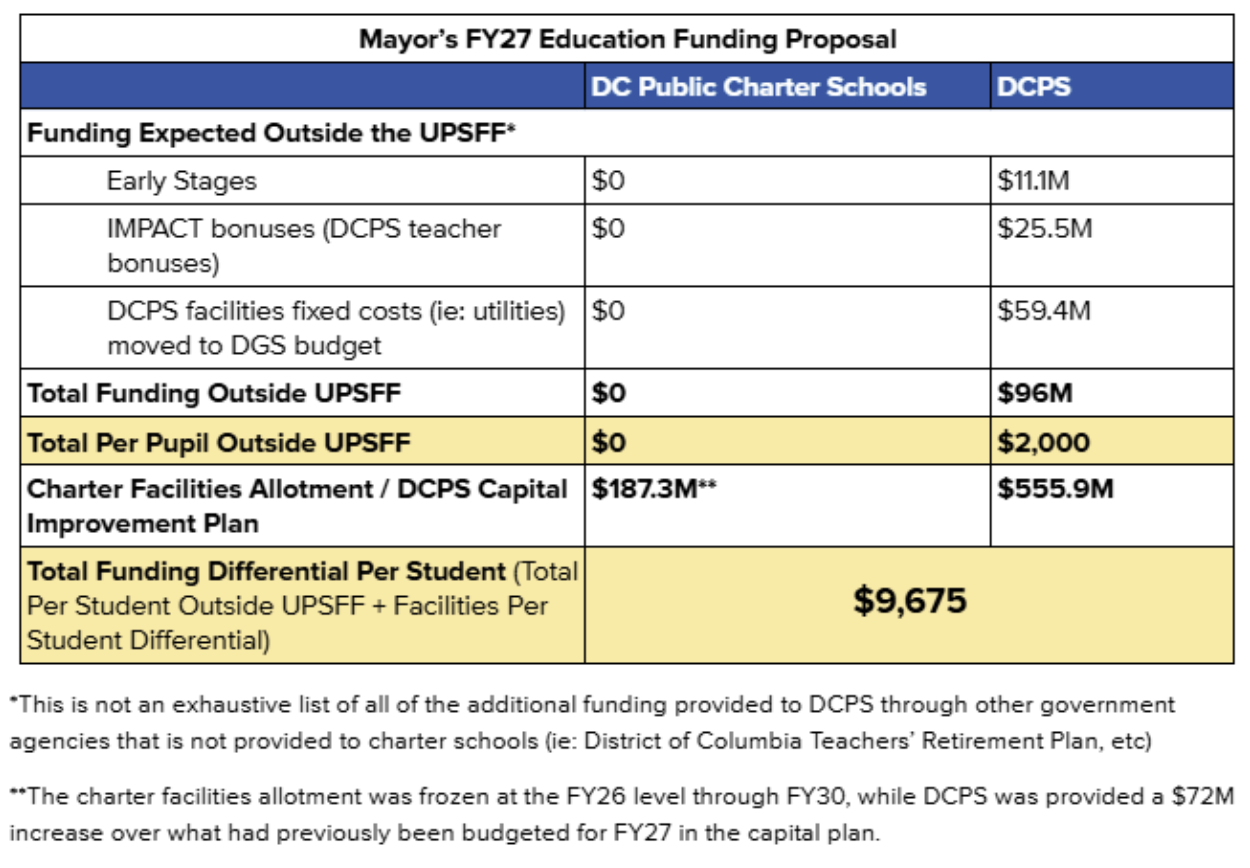
For the first time, the Mayor's budget proposes permanently moving $59.4 million in DCPS operational costs — electricity, gas, water, and waste management — out of the formula entirely, into the Department of General Services budget. In plain terms: the city will now cover DCPS's basic operating costs separately, outside the funding mechanism that is supposed to treat every student equally.
Students who attend charter schools will not see a single dollar of that $59.4 million. Their schools will continue paying utilities, and every other operational expense the same way they always have — through their per-pupil UPSFF allocation, just like the formula requires. Many charters school leaders will be forced to make impossible choices between retaining a reading interventionist or hiring a social worker and keeping the lights on. This isn't a technical budget maneuver. It's a policy statement. And the statement is this: the formula is optional when it's inconvenient for DCPS.
Once You Start, Where Do You Stop?
That's what makes this moment so consequential. The UPSFF works because the District applies it equally to fund the education of every public school student. The moment the city starts carving out categories of expenses for one sector — this year utilities, what's next? — students who attend charter schools are left behind by design.
When you consider the full budget proposal, the funding inequities are staggering. The proposed budget directs $96 million outside the formula exclusively to DCPS — including $25.5 million in IMPACT bonuses for DCPS teachers and $11 million for early childhood evaluations that students at charter schools must provide through their per-pupil funding alone. On top of that, DCPS is projected to receive $555.9 million in capital funding, compared to just $187 million for students at charter schools — who make up nearly half the city's public school population. The total gap? Roughly $9,675 less in resources for every child who attends a DC charter school.
What We're Asking the Council to Do
Equity in education funding means the formula has to mean something — for every student. We are calling on the DC Council to reject any budget that routes DCPS fixed costs outside the UPSFF, maintain the 3.1% annual charter facilities allotment increase, and reaffirm that DC's commitment to fair, transparent, formula-based funding is not negotiable.
Budget hearings have already begun. The stakes are high — not just for the upcoming school year, but for the students who depend on this city to fund their education fairly.
To testify or get involved, visit dccharters.org or email info@dccharters.org.