
Testimony Before the Council of the District of Columbia Committee of the Whole Hearing on Teacher and Principal Retention
By Noah Dougherty
Director of School Talent and Academic Strategy
Good afternoon, Chairman Mendelson and members of the Committee. My name is Noah Dougherty, I’m a Ward 2 resident and the Director of School Talent and Academic Strategy at the DC Charter School Alliance, the local non-profit that advocates on behalf of public charter schools to ensure that every student can choose high-quality public schools that prepare them for lifelong success.
I want to thank the Council for continuing to hold this public hearing annually. We know from both research and anecdotal evidence the positive impact that retaining high quality teachers and Principals has on student achievement. I also want to thank OSSE for the apprenticeship program they run to help paraprofessionals become teachers and the SBOE for making support of early-career teachers a priority. This work contributes to a broader ecosystem of support that helps DC attract and retain excellent educators.
I am excited to share three headlines on teacher and principal retention from our city’s public charter schools:
First, for the third year in a row, the public charter sector has seen a steady increase in its teacher retention rate.
Second, public charter schools are using their flexibility to find innovative ways to attract and retain excellent teachers.
Third, the best way to improve both teacher and principal retention in the long-term is to give educators equitable pay and the flexibility to focus on their job.
The public charter sector has seen a steady increase in its teacher retention rate.
The public charter sector’s Stayer retention rate increased by 19% in the last four years and our Leaver rate decreased by 30% in the same period. We are improving our teacher retention rate, despite having fewer financial resources. And while this fact points to our schools’ ability to do more with less, our teachers still serve the same public school students as our friends at DCPS. And students attending public charter schools are no less deserving of excellent educators who should be equally valued by the budgetary decisions of our city’s policymakers.
Public charter schools are using their flexibility to find innovative ways to attract and retain excellent educators.
Our schools are designed to have more flexibility to experiment with innovative practices. We appreciate the opportunity to share some of those practices in this public forum:
Wellness days and wellness centers
Flexible work locations on PD and conference days
Teacher-directed professional development budgets for their own growth
Immigration legal assistance for staff members
Virtual and on-site counseling services for staff to use during their planning periods
Retention bonuses, supply stipends, technology reimbursements, PTO buyback plans
Free before and after care for the children of staff members
Innovative and creative solutions to attract and retain excellent teachers is something public charter schools have always been at the forefront of. And we commit to doing a better job of sharing these practices and the lessons we’ve learned with the public and our public officials. All we ask for, is the continued flexibility of public charter LEAs to responsibly experiment to find the solutions that best fit the needs of their unique community.
The Alliance has heard from our member LEAs that one of the key factors that improves Principal retention is having a high-performing leadership team. This allows Principals to focus on the work of building a strong culture that improves outcomes for students. In response, the Alliance launched the New Instructional Leaders cohort, a group of 30 new school leaders from 22 LEAs across nearly every Ward, 73% of which are single-site LEAs. Experts from prominent local and national organizations lead these sessions, offering valuable perspectives, advice, and guidance for new people managers.
The best way to improve both teacher and principal retention in the long-term is to give educators equitable pay and the flexibility to focus on their job.
It is a common refrain that teachers must be all things to their students: instructors, counselors, social workers, food and housing specialists, behaviorists, and coaches. We reject this narrative. I was a teacher for eight years and it is a beautiful and complex profession that requires constant learning, agility, patience, problem-solving, and care to do well. It is already a multi-faceted job; teachers must be subject matter experts who understand instruction, assessment, curriculum, adolescent development, special education and EL services; they must have classroom management skills, emotional intelligence, and be able to collaborate with colleagues and families.
Teacher burnout is not solved by adding more well-intentioned expectations, trainings, or unfunded policies that can only be shouldered by teachers. Proximity to students is not a good enough reason to give schools one more thing to do. And Principals need the flexibility to prioritize the needs of their specific community, and to do so without artificial time constraints or regulations so burdensome they limit impact.
Teachers are professionals who should be respected enough to be paid well and allowed to focus on meeting the academic needs of their students. Our public charter schools will continue to struggle to provide the sustainable salaries our teachers deserve as long as they are not provided equitable, predictable teacher pay funding through the UPSFF.
Recommendations
Shifting the narrative that teachers should be all things to their students is no small-task, and we believe there are several immediate policies and approaches that can move us in that direction:
Pay all public school teachers well and fairly. We urge the Council to increase the UPSFF and to run all school funding through this formula, including educator compensation increases. Our teachers serve this city’s public school students and our LEAs should be equitably funded to honor their work.
Principals need more flexibility to lead successful schools. Overregulation ties the hands of Principals and contributes to burnout. School leaders must already navigate a system that is more litigious and politically fraught. Similar to our recommendation for teachers, proximity to students does not automatically make schools the best place for every well-intentioned program. And the more requirements we pass and programs we hoist onto schools, the more we prevent Principals from navigating the unique needs of their students and staff, and push them out of their pivotal role.
Fund effective wraparound services, so that this does not unintentionally become another responsibility for schools and teachers. When the social-emotional and basic needs of students are not met, educators often take on this work. When there are not enough social workers, schools spend more time connecting students to services. When there are not enough counselors, teachers spend more time supporting students in a crisis. Educators constantly step-up, until they burn out. Educators leave when the extra work becomes unsustainable and when there is less and less time to focus on their core job of teaching and learning.
I deeply appreciate the opportunity to share our celebrations, insights, and recommendations with this body and welcome any questions you have.
Appendix
Teacher retention: Year-over-year comparison
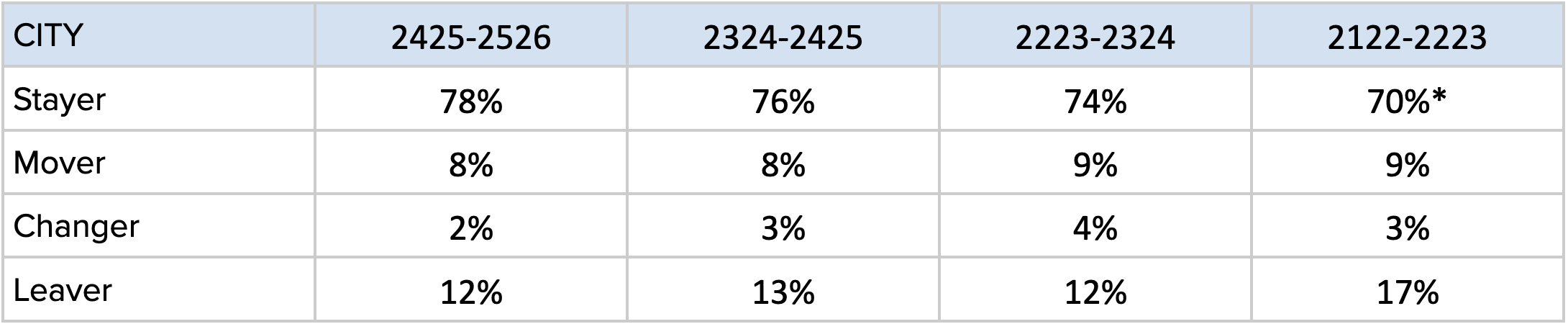
*The retention rate in the 22-23 Brief is listed as 70% and in the 24-25 Brief is listed as 71%
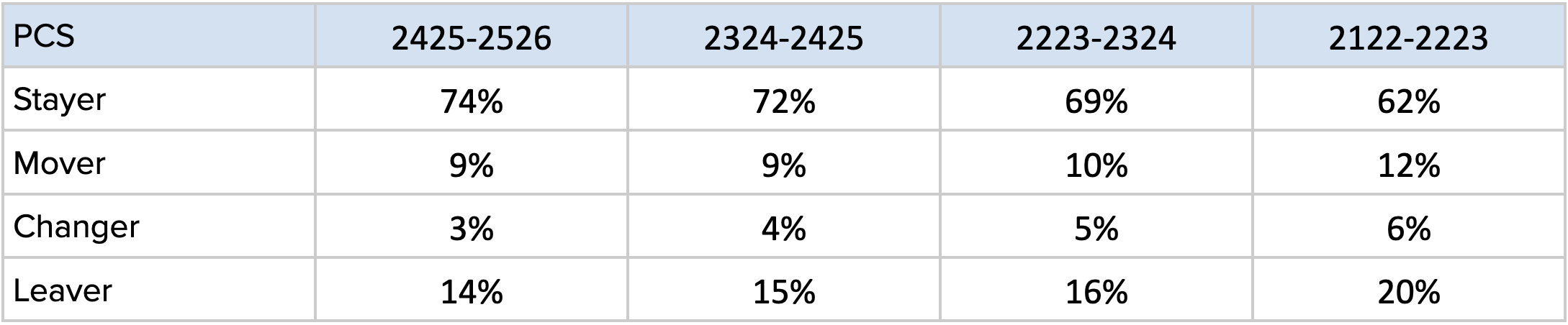
OSSE-designated terms:
Stayer: Same role type, same school
Mover: Same role type, new school
Changer: new role type
Leaver: No longer employed at a public LEA/SPA in DC