
Testimony Before the Council of the District of Columbia Committee of the Whole Fiscal Year 2027 Budget Oversight Hearing on the Public Charter School Board and DC Public Schools
By Ariel Johnson
Executive Director, DC Charter School Alliance
Good morning, Chairman, Councilmembers, and staff. My name is Ariel Johnson, and I am the Executive Director of the DC Charter School Alliance and a resident of Ward 5. Thank you for the opportunity to submit testimony on the FY27 budget.
This year marks a significant milestone: the 30th anniversary of public charter schools in the District of Columbia. Over the past three decades, public charter schools have become a fully integrated and essential part of DC’s public education system. Charter schools serve 48,000 students across the city and reflect the diversity, resilience, and innovation that define DC.
The District’s charter law is widely recognized as one of the strongest in the nation. It has enabled the creation of schools that meet a wide range of student needs— serving adult learners pursuing diplomas and career pathways, supporting overage and under-credited students working toward graduation, and operating residential programs for children whose home environments cannot provide all the wrap around services a student may need. Not to mention the diverse array of K-12 options that provide language immersion, arts, expeditionary learning models, and many more. Charter schools are also national leaders in special education, with institutions such as St. Coletta’s delivering high-quality services to students with diverse and significant needs.
Despite this strong foundation, charter schools are consistently forced to advocate for something that should be automatic: full and fair funding through the Uniform Per Student Funding Formula (UPSFF).
In recent years, funding has increasingly been moved outside of the UPSFF, undermining the transparency, predictability, and integrity of the formula. This practice creates instability for schools and inequities for students. The result is clear: students are harmed, and opportunities for success are diminished.
The FY27 proposed budget includes $96 million outside of the UPSFF for DCPS only. This shortchanges public charter school students approximately $2,000 per pupil. For many schools, particularly smaller ones, this is not a marginal adjustment. It is a profound disruption.
Consider Social Justice Public Charter School. This school opened during the pandemic, navigated academic and financial challenges, and struggled to find a permanent facility. But under their strong and passionate leader, Myron Long, they’ve overcome all of it, citing some of the best growth in Math and ELA among their peers. Its leadership, staff, and students have demonstrated resilience and progress under difficult circumstances. Yet under this proposed budget, the school will not receive the $200,000 that its DCPS peers would receive, despite its school leader and educators doing everything asked of them. This proposed budget threatens staffing, programming, and student support. Just when they are finally hitting the ground running.
While smaller LEAs will bear the brunt of these budget allocations, all LEAs will have to make difficult tradeoffs, including reducing staff, eliminating programs, and scaling back critical services that support student success.
In addition, the Mayor’s proposal to freeze the charter facilities allotment rate at the FY26 level through FY30 while increasing the DCPS capital budget by $72M over what had previously been budgeted for FY27 in the capital plan will exacerbate these challenges. Schools will be required to redirect limited classroom resources to cover basic building needs— ensuring that facilities are safe, functional, and conducive to learning. A recent survey we conducted found that charter schools’ utility costs rose by an average of 20% from the 2024–25 school year to the current year. This creates an untenable situation in which funds intended for instruction are diverted to keep the lights on.
The District has long been recognized as a national leader in public education and in supporting high-quality charter schools. However, in recent budget cycles, the conversation has shifted from innovation and partnership to basic compliance with existing law. Instead of working collaboratively across sectors to address shared priorities such as student safety, transportation, literacy, and attendance, we are forced into a recurring defensive posture around funding equity.
This moment calls for a reset.
As the District prepares for future leadership, both in the Mayor’s office and on the Council, we have an opportunity to recommit to a public education system that partners with students, families, educators, and school leaders. Upholding the integrity of the UPSFF and ensuring equitable funding are critical first steps.
At its core, this issue is about values. Funding decisions reflect what and whom we prioritize.
We urge the Council to fully fund the UPSFF, restore critical resources, and ensure that all public school students, regardless of sector, are valued equally.
Our students deserve nothing less.
Thank you for your consideration.
Understanding Proposed FY27 Education Funding
This information is updated based the Mayor’s formal budget submission to the Council, as of April 14, 2026
The Mayor’s proposed 2.55% UPSFF increase, which brings the foundation to $15,454,
is intended to cover educator pay increases— but to fully fund the city's portion of the
WTU agreement, the UPSFF would need to increase by 5%
To fully fund these increases for DCPS, the Mayor’s proposal offloads $59.4M
in DCPS fixed costs to DGS (eg: utilities)— outside the formula
This means charter schools receive $0 of that $59.4M, while DCPS
benefits entirely.
This means that charter schools will receive $2,000 less per student to operate
school programs
The proposal includes $555.9M for DCPS in capital funding for school modernizations
and major upgrades. In comparison, charter schools, who serve nearly half the District’s
students, would receive just $187.3 million. Meanwhile, there is no facilities allotment
increase for charter schools in this proposal. That’s a $368.6 million difference in
funding to support state-of-the-art school buildings for charter school students.
In total, the difference in funding is $9,675 less per student for charter schools.
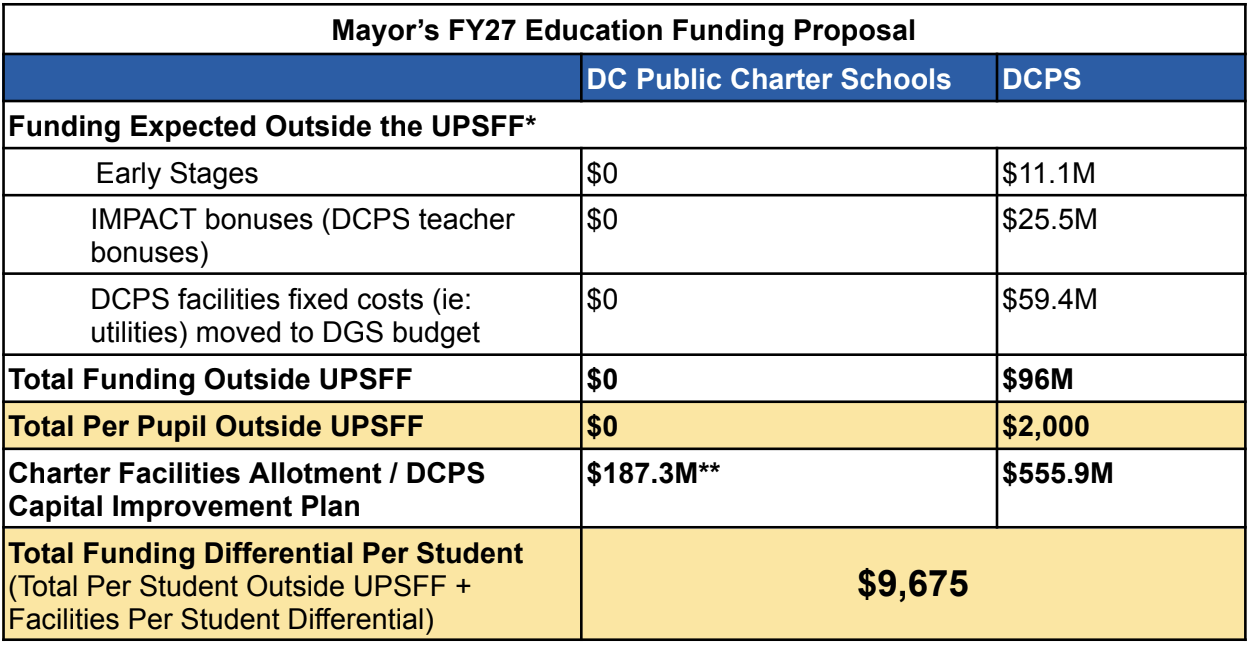
*This is not an exhaustive list of all of the additional funding provided to DCPS through other government agencies that is not provided to charter schools (ie: District of Columbia Teachers’ Retirement Plan, etc)
**The charter facilities allotment was frozen at the FY26 level through FY30, while DCPS was provided a $72M increase over what had previously been budgeted for FY27 in the capital plan.