
Dante’ Pope is Using Music to Change Students’ Lives
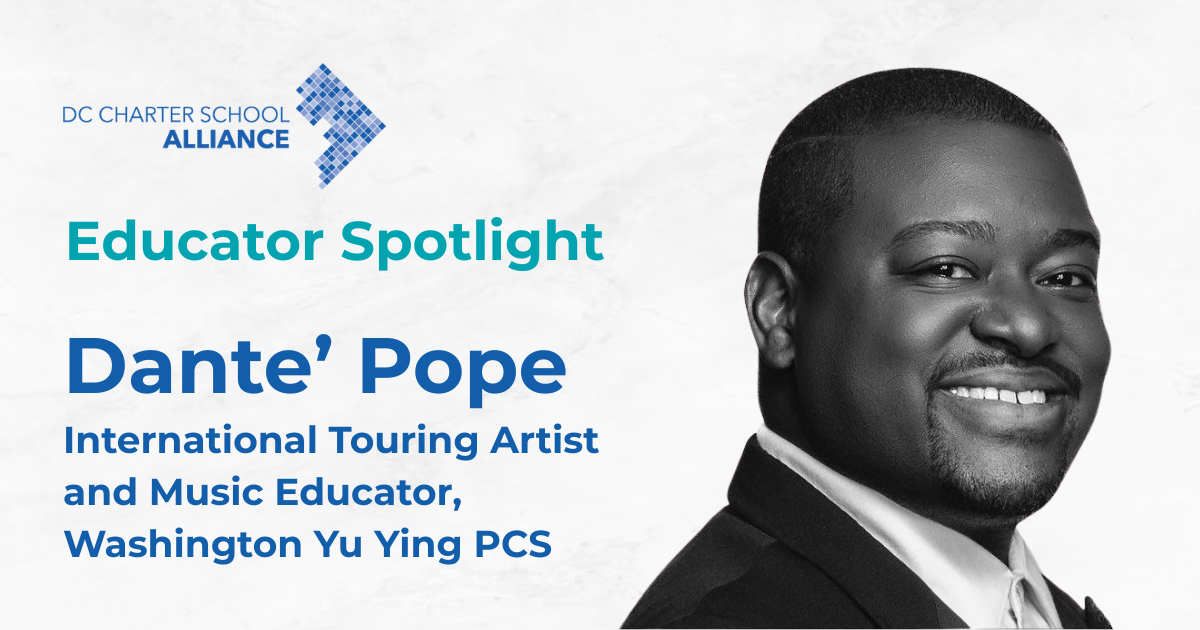
March is Music In Our Schools Month, and we spoke with Dante’ Pope, a music educator at Washington Yu Ying Public Charter School and Grammy-winning group member, about how music education is shaping students’ confidence, creativity, and connection to culture across the city. With a background that spans performance, advocacy, and classroom teaching experience, Dante’ brings a unique perspective on the role music can play in helping students see themselves in a broader global and historical context. In this Q&A, he shares more about his journey and how his work continues to impact students both inside and beyond the classroom.
DC Alliance (DA): You've worn a lot of hats. You're a Grammy-winning group member, touring musician, solo EP artist, and you embrace the label multi-genre, multi-disciplinary artist. Where does that diversity of interest come from?
Dante’ Pope (DP): I am a Chicagoan [and I’m] the son of ministers and educators. I'm from a community of very diverse, multifaceted people. I can't say it was a choice as much as it was something that was observed, absorbed, and repeated. Raised in the church, I played drums there. Once I got introduced to classical music, I then started going to a Conservatory Downtown Chicago, [the] Merit School of Music. And then the artists that I lean towards for a representation of the whole human being, especially as an African American man, like Paul Robeson and Harry Belafonte. My frame of reference in general are people that are much more like myself, in that I'm able to live out where I feel called to be, versus it solely being about the dollar, which is so important, but I've been blessed to find success and follow that voice.
DA: Was there an educator, or people in your close network that really cultivated that interest for you?
DP: I would have to say the king, who I just recently lost, my grandfather. The oldest of nine, sharecropping family, grew up in Kilmichael Mississippi. Him being such a great orator and galvanizer and bringing people together. He pastored for over 50 years, and was very involved politically in the city as well. On the education front, I would go with this gentleman named Euclid Williamson. He’s on the board of the Jackie Robinson scholarship, and he started a program called Target H.O.P.E., that was also in downtown Chicago. But Euclid was a person that gave me some possibility or ideas of possibility of me being more than just a musician, because that's all I wanted to do. Musically, I would have to go with Paul T Kwame, who we also recently lost. I went to Fisk University and was a member of the Fitz Jubilee Singers. So being a part of that ensemble, and having him as such a great singer, he had a way of making you own and embody what you were singing, which I've rarely found in many choral directors, but he was so amazing at that.
DA: I want to ask you about actually being a music educator. How did you decide to take it on as a key part of your career, and what has been the most rewarding part of your time as a music educator?
DP: I love people so much that any job where I can engage, I'm happy. Post college, I went back home to the west side of Chicago. In 2007, I was the 21st Century manager for Bethune Elementary School on the West Side of Chicago. I used some of my creativity to create programs where kids think and get an idea and opportunity to just grasp at some hope. I migrated to DC because the Congressman I had interned for hired me to become a staff assistant. I thought I was going to just be a member of Congress, until I was exposed to the DC music scene, and it changed my trajectory.
What helped me was a reference to Two Rivers Public Charter School. I started substitute teaching there in 2013. I step[ped] up as the short term music teacher in the fall before going on tour, because I wanted to be a musician, and the families dug it. I was in conversations with one of the founders of the school, and by that spring, I [was] teaching pre-K through 8 at Two Rivers. I was there for about two years teaching and learning how to structure my ideas, learning how to plan and think critically. I was on tour the last couple of years, eight to nine months out of the year. While it was a great experience, it wasn't as sustainable. In looking to transition back to DC, a community member from Yu Ying [Public Charter School], happened to be someone whose son I used to give drum lessons to and they were in need of a long term music teacher, and the rest is history. It's been nice being at a school that culturally has so much going on and gives [me] opportunity to really dive into history that is thousands of years old. To be able to speak to instruments that go past Beethoven and also say that, but before the mark of when this instrument was made 2,500 years ago in China, 2,500 more years ago on the continent of Africa, we could find the same tool. It's been a nice way to still be able to speak to a global history that includes Black people.
DA: Talk to me about what it is like to see kids’ worlds open up when they learn from you?
DP: I'll talk about it from two different spaces. I would say one is integrated classrooms. That term, as I'm learning and growing in my education politics, is one that is frustrating to some parents and to a lot of teachers, because you have to speak to, teach and be able to scale to [students] who [are] highly proficient, moderately proficient [or] neurodivergent. As an art teacher, I get a chance to see the throughline of what education can do. Outside of that, the benefit of affirming these kids. I got a note from a parent a couple of months ago, and it really touched me. And she said, “My daughter's been having problems zipping her coat, and we were about to leave out this morning, and I offered to help. And she said, ‘Mr. Dante’ said musicians are superheroes, so I think I could do it on my own.’ ” I wouldn't think that this preschooler would remember the things I say to them.
DA: How has sharing your work online influenced your teaching, and how does it expand your impact?
DP: It's expanded my impact in that just putting things on the algorithm is going to attract it to you. I noticed [followers] really like the folk based stuff that I do and introducing instruments and songs that they may not have heard. I would say social media is a major part of a program that I do quite often called Arts to Advocacy. I made this program to teach kids how to be civically engaged.
DA: This month is Music In Our Schools month, and the theme is united through music to help raise awareness about the importance of funding quality music education in our schools. What's your message to lawmakers and advocates about the importance of this issue?
DP: I’ll just say, if you cap our funding, you cap the future. That's the best way to put it.